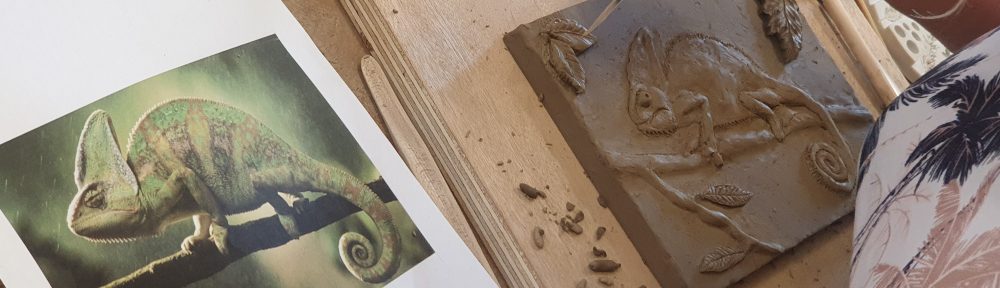
The fastest way to make a pot is probably on a potter’s wheel. This ingenious tool was invented in Mesopotamia by the Sumerians more than 5,000 years ago. However, thousands of years before that, people from many different civilizations and cultures were already making pots using a technique called coiling.
Coiling is one of the oldest pottery techniques and is still widely used in the ceramic world today. Many contemporary ceramic artists use coils to build their pieces.
While throwing a pot on the wheel is much faster, coiling offers far more possibilities when it comes to shapes and forms. You can create oval shapes, flowing curves, or even vases with multiple necks and openings. The possibilities are endless!
If you’d like to see how this technique works in practice, why not join us for a workshop? Two of the five upcoming ceramic workshops will focus on coiling.
As always:
- Places are limited.
- No previous pottery experience is required.
- All materials, firing, glazing and lunch are included.
- Once your pieces are ready, I’ll get in touch so you can pick them up from my atelier.
- For questions or registration, please call 697 422 11 51 or email schnyder.barbara@gmail.com.
And here’s the full program:
1. Ceramic Trivet in a Wooden Frame
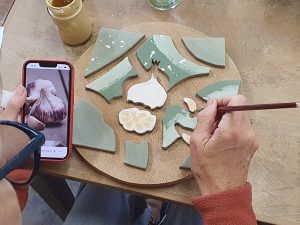 In this workshop, we will create a trivet consisting of a wooden frame and a composition of ceramic tiles. The process takes place over three sessions:
Designing and Cutting
The fixed size of the finished trivet (20 × 20 cm) will be our starting point for developing a design. It can be abstract, a mandala, a pattern, or a simplified motif that works like a puzzle or mosaic. Once we have our design plan, we knead and roll out white clay with chamotte, which is ideal for making tiles. We then cut an even square and divide it into the pieces needed for our design.
Painting and Firing
After about a week, when the clay has dried to a leather-hard stage, we apply coloured engobes and let them dry. After the first (bisque) firing, the pieces will be glazed and fired a second time. You can choose between a matte or glossy transparent glaze.
Assembling the Trivet
Once the ceramic tiles are ready, we meet for the third session to assemble the trivet. We carefully glue the pieces into a ready-made wooden frame and let everything dry. Your unique, handmade trivet will then be ready to take home.
7/11/26 Saturday, 10:00–12:00 designing, rolling out, cutting
14/11/26 Saturday, 10:00–12:00 painting the pieces
28/11/26 Saturday, 10:00–11:00 gluing the pieces into the wooden frame
2. Coiling a Vase

In this workshop, we will build a vase using the coiling technique. Step by step, I will demonstrate the basics of this method and guide you along the way with helpful tips and individual support.
The slow, hands-on process allows you to have greater control over the shape your piece takes. We will use white clay and decorate our vases with engobes (coloured clay slips) once the pieces have reached the leather-hard stage.
After the bisque firing, the vases will be finished with a transparent glaze, available in either a matte or glossy finish.
8/11/2026, Sunday, 10:00–16:00/17:00 including lunch
15/11/2026, Sunday, 10:00–13:00 decorating the vase
3. Coiling a Jug

In this workshop, we will build a jug using the coiling technique. Step by step, I will demonstrate the basics of this method and guide you along the way with helpful tips and individual support.
The slow, hands-on process allows you to have greater control over the shape your piece takes.
We will use white clay and decorate our jugs with engobes (coloured clay slips) once the pieces have reached the leather-hard stage.
After the bisque firing, the jugs will be finished with a transparent glaze, available in either a matte or glossy finish.
29/11/2026, Sunday, 10:00–16:00/17:00 including lunch
6/12/2026, Sunday, 10:00–13:00 decorating the jug
4. Building a Relief Picture
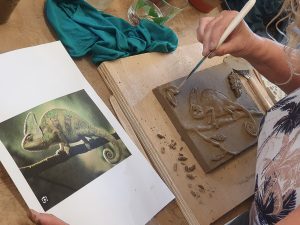
In this workshop we transform an idea or an image that we like into a three-dimensional picture. It could be a portrait, a landscape, a plant or animal, a mandala or just anything that you can imagine. There are no limits! After the pieces are fired we will meet again and paint them with acrylics.
22/11/2026 Sunday, 10:00-14:00
13/12/2026 Sunday, 10:00-13:00 painting and finishing the relief
5. Sculpting your Angel
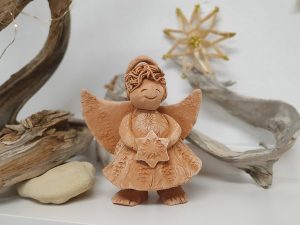
From simple ornaments to personal sculptures
In this workshop we create angels. After a short introduction into the subject and some examples of different kinds of sculptures we shape and model our own angel. This can be from simply decorativ to completely intuitiv and personal.
The finished angel sculptures will be dried and fired and will get that typical terracotta colour of the fired clay.
5/12/2026 Sunday, 10:00-14:00